SPIRITUS Youth Ministry
Four-Phase Model
The Four - Phase model consists of an initial retreat experience, Religious Education curriculum units, formation and engagement of the ministry team and connecting students into the broader Church.
Key Implementation Strategies
SPIRITUS Youth Ministry focuses on transforming Catholic schools into active hubs for evangelisation. They achieve this by networking leaders and teachers through three primary pillars: Student Ministry, Post-School Youth Ministers, and the Spiritus Leaders Network.
Four-Phase Formation Model: The backbone of student evangelisation. It begins with "kerygmatic" retreat experiences (Phase 1) and evolves into curriculum-integrated formation, the creation of senior ministry teams, and broader Church engagement.
Targeted Student Events: Schools are encouraged to participate in regional events like Shine and Lead (Secondary) and Illuminate (Primary) to spark initial faith engagement.
Youth Minister Integration: Schools leverage trained post-school youth ministers—graduates of "Equipping Schools"—to mentor current students and facilitate ministry programs.
Leadership Development: Staff and church leaders receive ongoing formation through the Spiritus Leaders Network, a collaborative initiative with ACU La Salle Academy designed to sustain the mission of evangelisation.
Key Goal: To provide a continuous "pathway" of faith, moving from an initial encounter to active leadership within the Church community.


Upper Primary Yrs 5 & 6
SPIRITUS Youth Ministry -Junior
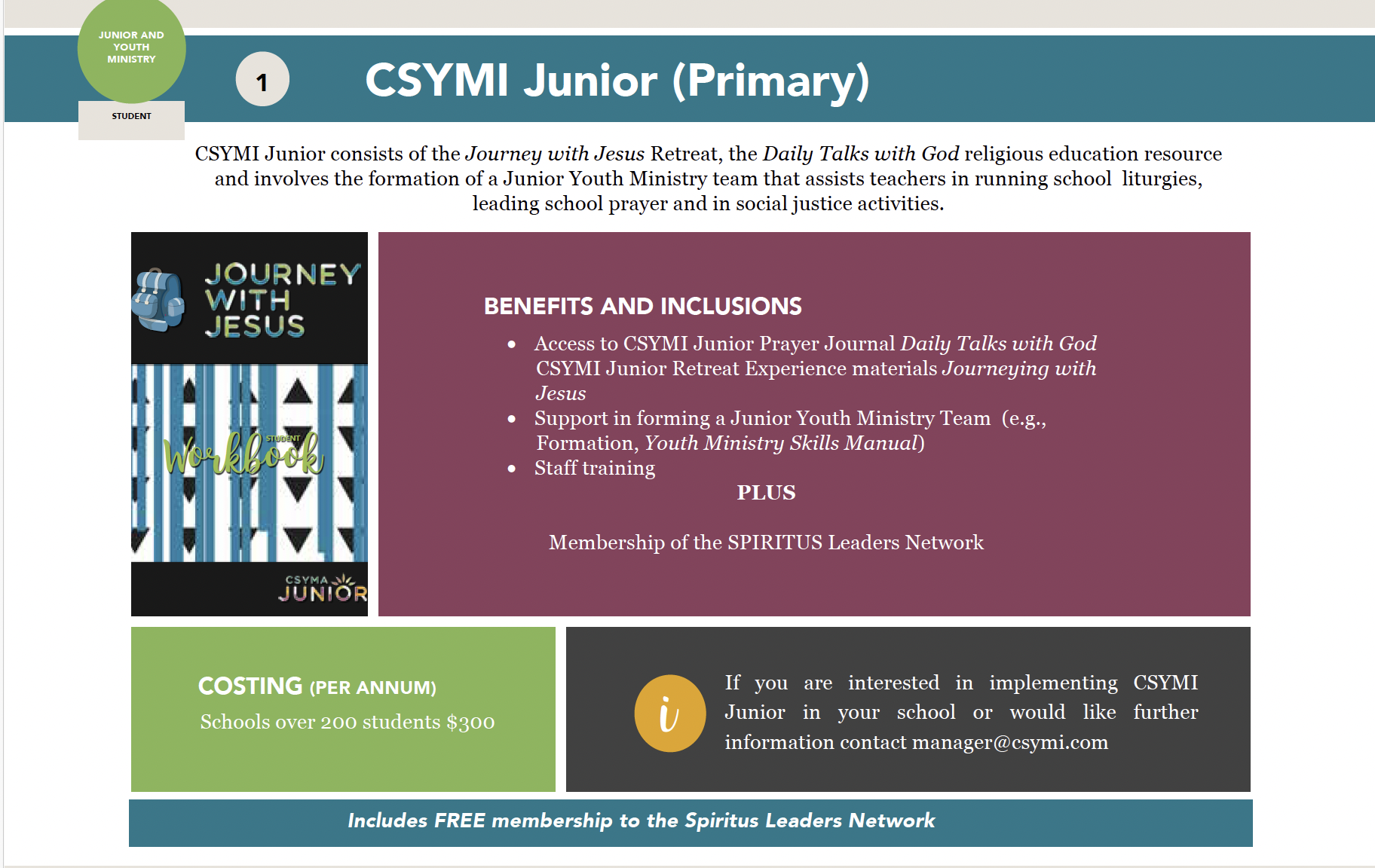
SPIRITUS Youth Ministry - Junior is a program designed for upper primary school students, which aims to deepen their faith through a four-phase process. Phase 1 is an initial retreat experience called Journey with Jesus, which consists of four videos focusing on God's love, salvation, forgiveness, and faith as a journey with Jesus. Phase 2 builds on the first phase using a Religious Education resource called Daily Talks with God. Phase 3 aims to establish a Spiritus Youth Ministry Junior Team that conducts small ministry or service outreach initiatives, and the Spiritus Youth Ministry Junior Skills Series booklet is used to guide the team in developing essential youth ministry skills. Phase 4 encourages students to connect with the broader Church, including parish and local Spiritus Youth Ministry senior youth ministry teams, for further formation and ministry opportunities.

Junior Secondary Yrs 7 & 8
The Amazing Race
The Amazing Race is a junior secondary curriculum resource that aims to complement and enrich the Religious Education curriculum. It can be used as stand-alone lessons or embedded within the existing curriculum or reflection days/retreat experiences.
The program focuses on teaching students about the Church as the Body of Christ, the Universal Church, God's saving plan for all creation, and how believers continue the mission of Jesus in the world. It also teaches students to evaluate and draw conclusions about the significance of rituals, prayer, sacraments, foundational Christian principles, scripture, and Church teaching.
The program consists of two modules covering topics such as youth ministry, evangelisation, forgiveness, and reconciliation.

Middle Secondary Yrs 9 & 10
Introduction to Youth Ministry & Leadership

This program offers a curriculum pathway for students in years 9 and 10 to learn about youth ministry and leadership. The program includes three phases: a youth ministry retreat or conference, two units of study in Religious Education (Introduction to Youth Ministry and Leadership and Ministry), and the establishment of a senior youth ministry team. The curriculum is designed to be taught as elective units of study and implemented as outlined in the manuals provided by Spiritus Youth Ministry. Upon completion of the program, students receive a Youth Ministry Training Certificate.

Senior Secondary 11 & 12
Spiritus
Youth Academy
The Spiritus Youth Academy is a program offered in partnership with the Australian Catholic University's La Salle Academy. The senior Youth Ministry Team conducts activities such as liturgies, mission trips, and service programs. The Spiritus Youth Ministry Equipping School prepares senior students for leadership and service in youth ministry and cross-cultural missions. The Spiritus Youth Academy consists of two programs: the Formation Program and Faith and the optional Outreach Program. Upon completion, students receive the Spiritus Youth Ministry and ACU Faith and Ministry Award, including five additional ATAR points towards an undergraduate degree at the ACU. Students must complete assessment tasks overseen by teachers using a marking rubric supplied by the ACU la Salle Academy.
Spiritus Youth Ministers Network
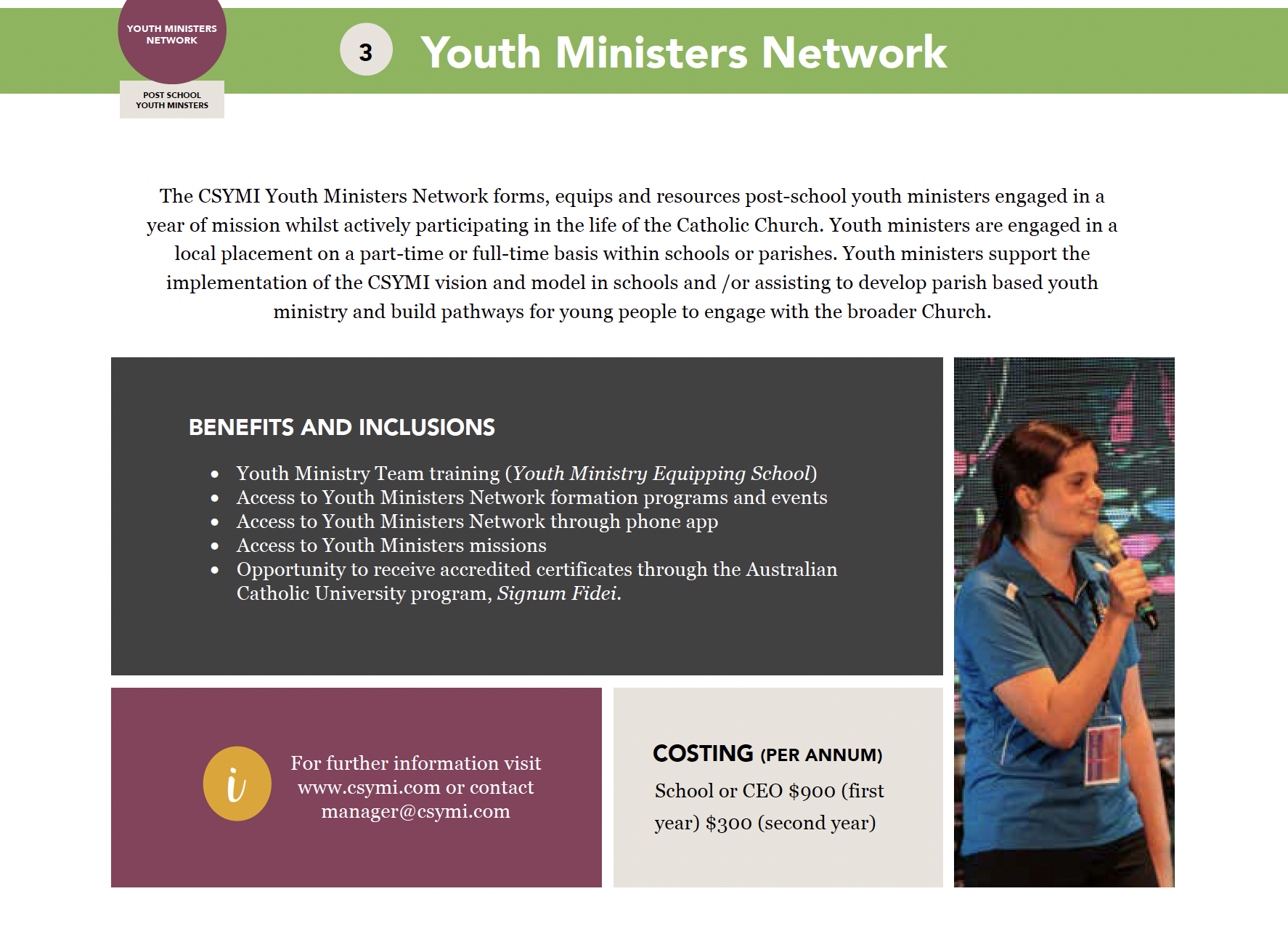
The Spiritus Youth Ministers Network is a network that forms, equips and resources post-school youth ministers engaged in a year of mission whilst actively participating in the life of the Catholic Church. Youth ministers are engaged in a local placement on a part-time or full-time basis within schools and/or parishes. Youth ministers support the implementation of the Spiritus Youth Ministry model in schools, develop parish-based youth ministry and build pathways for young people to engage with the broader Church. ACU-accredited Signum Fidei certificates are incorporated within the Youth Ministers Network formation and mission pathway.

Training and Accreditation of teachers
Training Programs and Resources
The Forming Leaders Series: Includes specific programs like Porta Fidei, Called, and Essentials for Faith Leadership, which focus on spiritual renewal and practical ministry skills.
Equipping Schools
Online training
Professional Certification
SPIRITUS Youth Ministry Educator Certification: To qualify, applicants must have completed a Youth Ministry Equipping School (YMES) or an online training course, alongside a retreat or formation experience within the last three years.
Diocesan Accreditation
Diocesan Recognition: Many Australian dioceses recognise these programs as meeting the requirements for accreditation to teach Religious Education and to teach/lead in a Catholic school. Teachers are advised to confirm specific requirements with their local Catholic Education Office.
Phases of Development
The four phases of implementation of the CSYMI vision for a local member country, include Connection, Establishment, Focus Area Plans, and Growing Youth Ministry. The phases involve building relationships, establishing leadership structures, developing key documents and plans, introducing CSYMI models of formation and mission, and growing youth ministry.

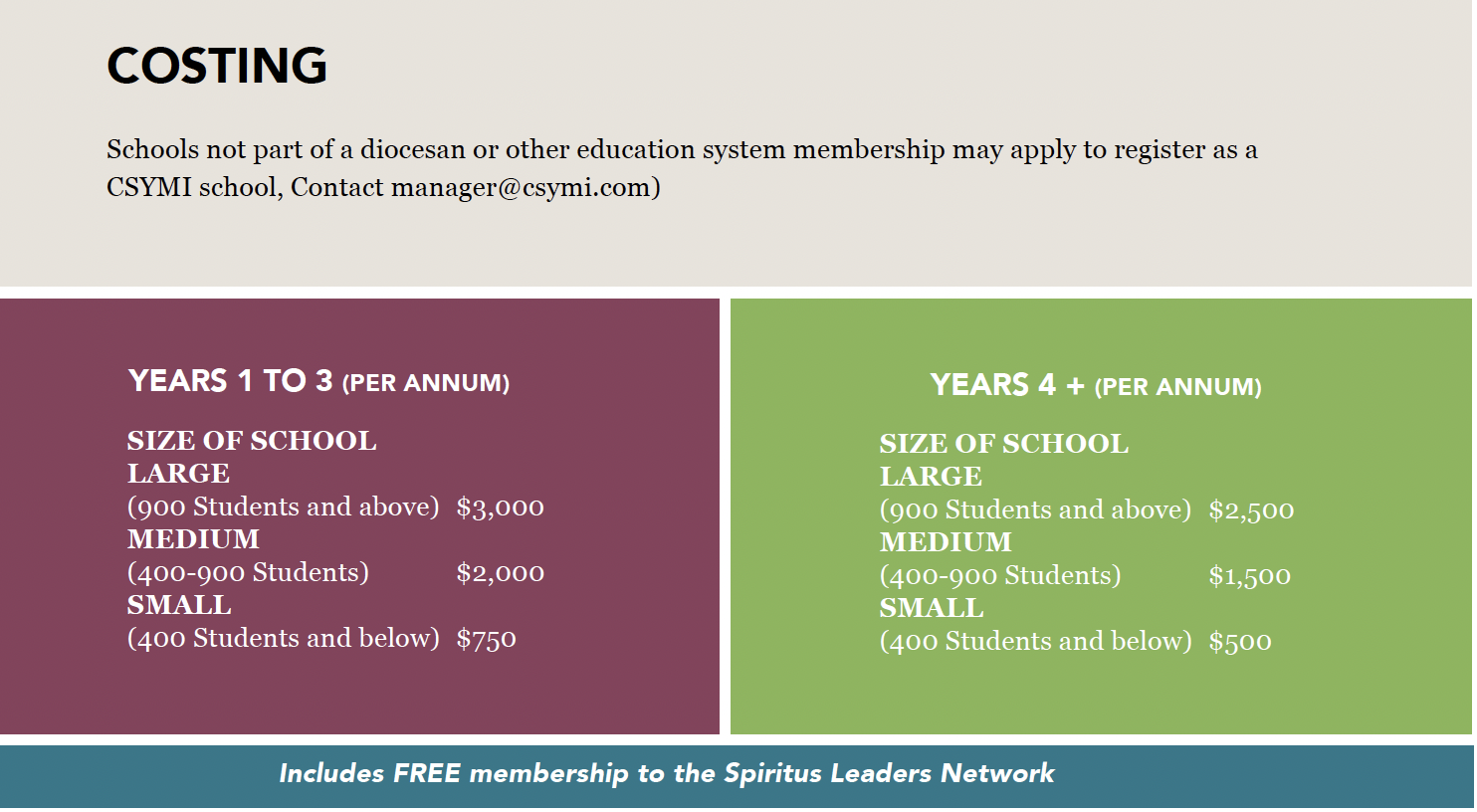
Pricing